
Wine is taught as geography, which requires memorising hundreds of regions, producers and vintages before you can order confidently. There is a shorter route. Almost every wine can be described by four structural properties, and food pairing is largely a matter of matching those properties rather than knowing names.
The four properties
- Acidity is the sharpness that makes your mouth water. High in Riesling, Sauvignon Blanc, Chablis, Champagne, Barbera and most Italian reds. Acidity cuts through fat and salt, and it is what makes a wine feel refreshing.
- Tannin is the drying grip on your gums, coming from grape skins and oak. High in Cabernet Sauvignon, Nebbiolo, Syrah and young Bordeaux. Tannin binds to protein and fat, which is why a tannic red and a steak improve each other and why the same wine is unpleasant with fish.
- Body is the weight in the mouth, from watery to viscous, driven mostly by alcohol and extract. Match the weight of the wine to the weight of the food, which is the single most reliable pairing rule there is.
- Sweetness is residual sugar. Almost all table wine is dry. Where sweetness exists it must be greater than the sweetness of the dish, or the wine will taste sour beside it.
You do not need to know a thousand producers. You need to know four properties, and then the list reads itself.
The rules that follow
- Match weight to weight. Light food, light wine. A delicate fish is destroyed by a heavy oaked Chardonnay and flattered by a Muscadet.
- Acidity beats fat. Anything creamy, fried or fatty wants a wine with real acidity. This is why Champagne and fried food is one of the great combinations.
- Tannin needs protein. Serve tannic reds with meat and hard cheese. With vegetables or fish, tannin turns metallic.
- Sweet with sweet. A dessert wine must be sweeter than the pudding. This is where most restaurant pairings fail.
- Match the sauce, not the protein. Chicken in a cream sauce and chicken in a tomato sauce want different wines, and the bird is irrelevant to the decision.
- What grows together goes together. Not mystical, simply the result of centuries of local cooking and local wine adapting to each other. Tuscan food and Sangiovese; Loire goat’s cheese and Sancerre.
What to buy at each price
Between 7 and 12 euro, buy from unfashionable regions where the same quality costs less: Portugal, southern Italy, Greece, south-west France, Spanish regions that are not Rioja. Between 12 and 20 you can buy genuinely good wine from almost anywhere, and this is where most people should spend for a dinner. Above 25 the increases are real but slow, and above 60 you are buying rarity and reputation as much as pleasure.
The best value on a restaurant list is usually the second or third cheapest bottle of a less fashionable grape, not the second cheapest overall, which is where restaurants know people look and price accordingly.
Serving, which is free and often wrong
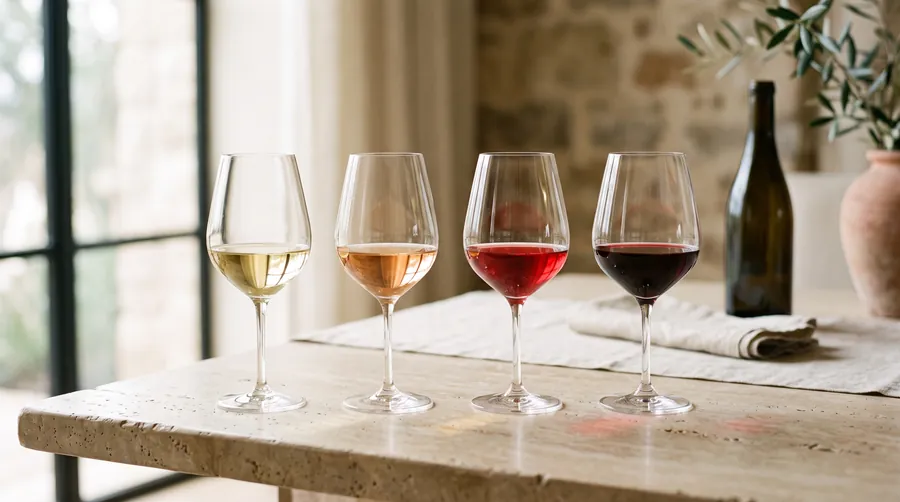
Almost all white wine is served too cold, at fridge temperature of 4 degrees, which mutes everything; take it out twenty minutes before pouring. Almost all red is served too warm, at a modern room temperature of 22 degrees, which makes it taste of alcohol; put it in the fridge for twenty minutes. The correct range is roughly 8 to 12 degrees for white and 14 to 18 for red, and a lighter red such as Beaujolais or Pinot Noir is delicious lightly chilled.
Use larger glasses than you think, fill them a third full, and open a young tannic red an hour ahead or decant it, which does far more for a 15 euro bottle than any amount of ceremony.
Try the tool
The TableMenu, timings and the settingQuestions we get asked
Is old wine better?
Only for a small minority of wines built to age. Most wine sold today is at its best within three years, and keeping an ordinary bottle for a decade produces disappointment rather than complexity.
Does screwcap mean cheap?
No. Screwcaps eliminate cork taint, which affects a few per cent of corked bottles, and several excellent producers use them. The closure says nothing about the quality inside.
How long does an opened bottle last?
Three to five days in the fridge with a stopper, whites and reds alike. A vacuum pump adds a day or two. Sparkling wine keeps its bubbles surprisingly well for two days with a proper Champagne stopper.