
Kitchen shops sell solutions to problems most people do not have, which is why so many drawers contain an avocado tool and no thermometer. What follows is the short list that a professional would keep, with realistic prices.
The six
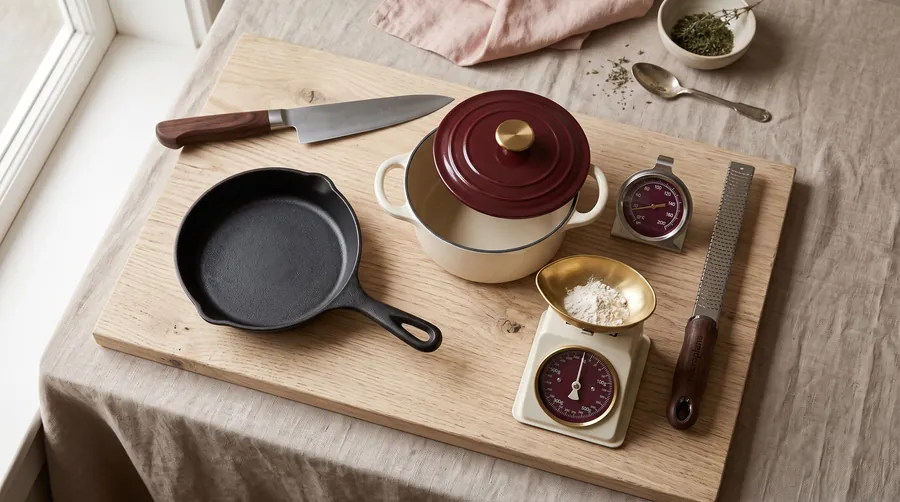
- A 20 centimetre chef’s knife. 40 to 120 euro. This does 90 per cent of all cutting. Hold several before buying, since the correct one is the one that feels balanced in your hand. A Japanese blade at 60 euro is harder, sharper and more brittle; a German blade is softer, more forgiving and easier to sharpen. Add a small paring knife at 15 euro and a serrated bread knife at 30, and the knife question is answered for twenty years.
- A heavy casserole with a lid, 24 to 28 centimetres, cast iron and enamelled. 60 to 300 euro depending on the name on it, and the 60 euro version performs almost identically. This cooks every braise, every stew, every soup, bread, and a roast chicken.
- A cast iron frying pan, 26 centimetres. 30 to 60 euro. It sears better than anything non-stick can, lasts a century, goes in the oven and improves with use. Keep one small non-stick pan for eggs and replace it every three years, since the coating does not last however careful you are.
- A digital probe thermometer. 15 to 40 euro. The single most underrated object in domestic cooking. It removes all guesswork from meat, fish, bread and custard, and it is the reason restaurant food is consistent.
- Digital scales. 15 to 25 euro. Baking is chemistry and cups are an imprecise instrument. Scales with a tare function let you weigh everything into one bowl.
- A microplane grater. 20 to 30 euro. Garlic, ginger, parmesan, citrus zest and nutmeg. It changes how food tastes more than any expensive ingredient at the same price.
The gadget drawer is where money goes to be forgotten. Six good tools, kept sharp and used daily, will cook anything you want to eat.
The three that come next
A large chopping board in end-grain wood, which is kinder to knives and to your hand than plastic. A wide sieve, which does the work of a colander and a sifter. And a stick blender, which makes soup in the pan and takes up no space.
What to skip
Garlic presses, which waste half the garlic and are unpleasant to wash. Knife blocks with fourteen knives, of which you will use three. Anything with a single function: avocado slicers, egg toppers, herb strippers, strawberry hullers. Copper pans, unless you intend to maintain them. And the stand mixer, unless you bake weekly, in which case it is wonderful and worth every euro.
Keeping the knife sharp, which is the whole thing
A blunt knife is the most dangerous object in a kitchen, because it slips. Use a honing steel before each session, which realigns the edge and takes ten seconds. Sharpen properly two or three times a year, either on a whetstone if you enjoy it or by a professional service at 5 to 10 euro a knife. Never put a good knife in the dishwasher, wash it by hand immediately, and store it on a magnetic strip or in a block rather than loose in a drawer.
Do that and a 60 euro knife will outperform a 300 euro one that has been neglected, which is true of almost everything in a kitchen.
Try the tool
The TableMenu, timings and the settingQuestions we get asked
Is expensive cast iron worth the difference?
The enamel on premium brands is more durable and the lids fit better, which matters over decades. For cooking performance, a mid-priced enamelled casserole is indistinguishable in a blind test.
Do I need a non-stick pan at all?
For eggs and delicate fish, it is genuinely easier. Treat it as a consumable, buy an inexpensive one, never overheat it and replace it when the coating marks.
What about induction?
Cast iron, enamelled iron and most stainless steel all work. Aluminium and copper do not without a magnetic base, which is worth checking before buying anything.