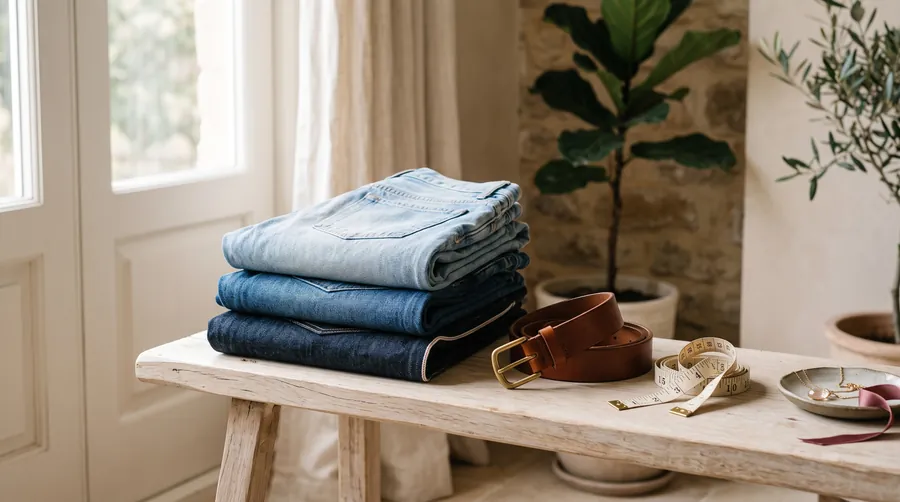

Denim is the most bought and least satisfying category in a wardrobe. The reason is not that bodies are difficult; it is that two variables, rise and rigidity, do almost all of the work and almost nobody is told what they are.
Rise decides the shape
The rise is the distance from the crotch seam to the top of the waistband, and it determines where the garment sits and therefore what your proportions look like. A low rise sits on the hip bones, cuts the torso at its widest and needs a long leg to work. A mid rise, at roughly 24 to 27 centimetres, sits just below the navel and suits the most bodies. A high rise, from about 28 centimetres, sits at the natural waist, lengthens the leg and, importantly, stays where you put it when you sit down.
If you have ever bought jeans that fitted in the mirror and were unwearable at a desk, the rise was the culprit, not the size. Measure a pair you already like: lay them flat, run a tape from the top of the front waistband to the crotch seam, and write the number down. It is a more useful piece of information than your size.
Elastane is a loan against fit. It gives you comfort today at the price of shape by Thursday.
The elastane trap
Most jeans on the high street now contain 1 to 3 per cent elastane. At 1 per cent you get a little give and a garment that mostly recovers overnight. At 2 per cent you get comfort in the changing room and a pair that has grown a full size by the end of a working day, because the elastane stretches and the cotton around it does not spring back. Above 3 per cent you are wearing jeggings, which is a legitimate choice but not the same garment.
Rigid denim, with no elastane at all, behaves in the opposite way. It is uncomfortable for about a fortnight, then moulds to you and stays there for years. It also holds a shape at the seat and thigh that stretch denim never manages. If you have the patience, rigid or nearly rigid denim between 12 and 14 ounces is the pair you will still be wearing when the others have sagged.
How to buy, in order
- Fit the hip and thigh first. These cannot be altered without recutting. The waist can always be taken in.
- Sit down in the changing room. For a full minute. Then stand up and look at the back.
- Check the waist gap. Two or three centimetres of gap at the back is normal on a curved figure and is a 25 euro alteration. Ten centimetres means the wrong cut.
- Ignore the number on the label. Denim sizing varies by four centimetres between brands, and vanity sizing has made the number meaningless. Take three sizes into the room.
- Decide about the hem last. With the shoes you will actually wear. A hem is 15 to 25 euro and transforms the proportion, and a good shop will keep the original stitching for you if you ask.
Care, briefly
Wash cold, inside out, as rarely as the pair will let you. Every wash costs you colour and a little recovery in the fibres. Hang them to dry rather than tumbling; the dryer is what kills the elastane and the waistband. If they are only slightly worn, air them overnight instead. Jeans washed once a fortnight rather than after every wear last roughly twice as long and look considerably better doing it.
If you want the sizing translated between countries, the Fit Guide converts EU, UK, US, French and Italian numbers and, more usefully, tells you which measurement each system is actually describing.
Try the tool
Fit GuideSizes that mean the same thingCapsule WardrobeThirty-eight pieces, counted honestlyQuestions we get asked
Should I size down in rigid denim?
Take your true size and expect it to relax by about a centimetre at the waist within two weeks. Sizing down is only sensible in genuinely raw, unwashed denim, which is a specialist purchase.
Are expensive jeans better?
Between roughly 90 and 180 euro, yes, you are usually buying better cotton, honest sizing and stitching that survives. Above 250 you are buying a name and a wash.
How do I stop the waist gap?
Buy for the hip and have the back seam taken in. It is the most common alteration in every tailor shop in Europe and takes twenty minutes.