
New jewellery loses between 50 and 70 per cent of its price the moment it becomes second-hand, which is the least discussed fact in the industry. Estate jewellery has already taken that loss, which means the person buying it at auction is buying close to intrinsic value and has somewhere to sell if her taste changes. It is also, more often than not, better made.
Where the pieces are
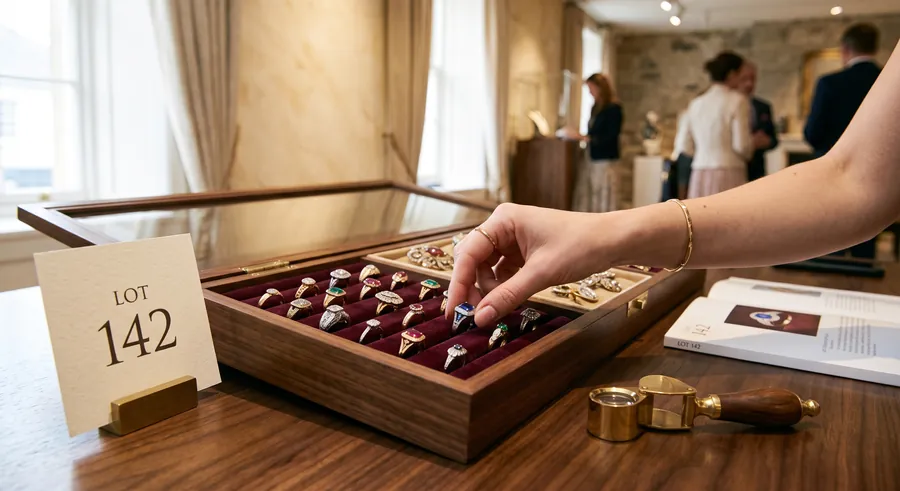
Regional auction houses are where the value sits. The famous international houses handle the extraordinary and charge accordingly; a provincial saleroom in a market town sells excellent Victorian, Edwardian and mid-century pieces to a much smaller audience. Online bidding has narrowed that gap but not closed it, and a Tuesday morning sale in a small town remains one of the last inefficient markets in luxury.
Antique jewellery dealers and estate sections in good jewellers cost more than auction and remove nearly all the risk, which for a first purchase is a reasonable trade.
The retail mark-up on new jewellery vanishes the moment you leave the shop. At auction you are buying at roughly the price the shop paid.
The arithmetic of a bid
The hammer price is not what you pay. Add the buyer’s premium, typically 20 to 28 per cent, then VAT on the premium, then any online platform fee of 3 to 5 per cent, then shipping and insurance. A 1,000 euro hammer becomes roughly 1,300 to 1,400. Work out your maximum total first and bid backwards from it, because the room is designed to make you round upwards.
What to inspect, in order
- The setting, not the stone. Worn claws, thin shanks and previous solder repairs are what turn a bargain into a restoration project. A jeweller will quote 80 to 300 euro for re-tipping claws.
- Hallmarks. British hallmarking gives you metal, assay office and date letter, which dates a piece precisely. Continental marks are less complete but a lack of any mark on supposedly high-karat gold deserves suspicion.
- Signs of conversion. Brooches turned into pendants and rings resized past their limit are common and reduce value considerably. Look for solder lines and uneven shank thickness.
- Stone condition. Old cuts are meant to look softer than modern brilliants; that is charm, not damage. Chips at the girdle are damage, and they are found by running a fingernail around the edge.
- The condition report. Request it in writing and read what it does not say. Auction descriptions are legally careful; the absence of the word original is meaningful.
Periods worth knowing
Victorian, roughly 1837 to 1901: yellow gold, seed pearls, garnets, sentimental motifs, often remarkable value. Edwardian, 1901 to 1915: platinum lace work, milgrain, delicate and fragile. Art Deco, 1920s and 30s: geometry, calibre-cut stones, the most collected and therefore the most faked. Retro, 1940s: bold yellow and rose gold, large semi-precious stones, currently the best value on the market. Mid-century, 1950s and 60s: textured gold, modernist Scandinavian silver, rising steadily.
The three rules
Buy the piece rather than the period, because a signed Art Deco ring in poor condition is worse than an unsigned Retro one in excellent condition. Set your maximum before the sale and write it down. And handle as many pieces as you can before you bid on anything, at fairs and in dealers’ cabinets, because the education is free and the difference between a good piece and a tired one becomes obvious surprisingly quickly.
Try the tool
Jewel BoxRing gauge, chains and stonesQuestions we get asked
Is it safe to bid online without seeing a piece?
For lower value lots with a detailed condition report, generally yes. Above about a thousand euro, either view in person or buy from a house that accepts returns on misdescription.
Can vintage rings be resized?
Usually, though eternity bands and rings with stones set all the way round often cannot. Ask the auction house for the current size and assume 60 to 150 euro for resizing.
Are antique diamonds worth less?
They are priced differently. Old European and rose cuts have less brilliance than modern cuts and a softer glow that many people prefer. Per carat they often cost less, which is a genuine opportunity.