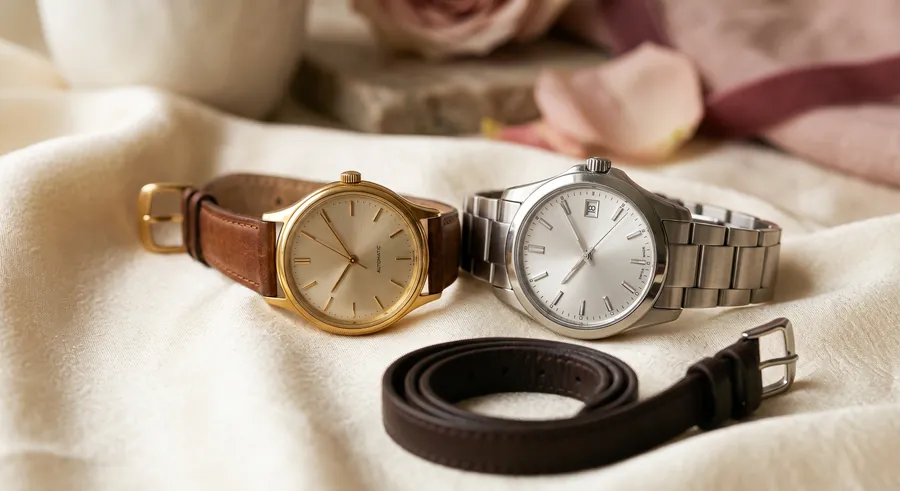

Women’s watches have been badly served for decades: shrunk, jewelled, fitted with movements nobody would put in a men’s watch and priced as accessories. That has changed considerably in the last ten years, partly because smaller case sizes came back into fashion generally, which means the interesting watches are no longer only in the men’s cabinet.
The movement question
Quartz runs on a battery, keeps time to within seconds a month, costs little to maintain and needs a new cell every two to four years. It is not a lesser choice; it is a different one, and a good quartz watch is accurate, thin and unfussy.
Mechanical means a spring and gears, wound by hand or by the movement of your wrist. It loses or gains several seconds a day, needs servicing every five to seven years at 300 to 800 euro, and will run for a century if maintained. What you are buying is not accuracy; it is an object made of a hundred small parts that can be repaired indefinitely.
The honest guidance: if you want a watch to wear and forget, buy quartz and spend the money on the case, the dial and the bracelet. If the mechanism itself is part of the appeal, buy mechanical and budget for servicing from the start.
A watch you have to think about winding is a watch you have a relationship with. That is either the appeal or the objection, and only you know which.
Size, which matters more on a smaller wrist
Measure your wrist with a tape. Under 15 centimetres, look at 26 to 32 millimetre cases. Between 15 and 17, the 32 to 36 range is comfortable and 36 is the most versatile size in watchmaking. Above 17 centimetres, 36 to 40 works easily.
Two numbers matter as much as the case diameter and are almost never advertised. Lug to lug is the length across the case including the horns, and it decides whether a watch overhangs the wrist; it should not exceed the flat width of your wrist. Case thickness decides whether it slides under a cuff; under 11 millimetres is elegant, over 13 is a sports watch.
What each price band buys
- 150 to 400 euro. Excellent quartz from Japanese and German makers, sapphire crystal at the upper end, honest design. A Seiko, an Orient or a Junghans here will outlast most jewellery.
- 400 to 1,200 euro. Entry mechanical: Swiss or Japanese automatic movements, sapphire, decent finishing, real bracelets. This is where a first mechanical watch sensibly lives.
- 1,200 to 4,000 euro. In-house or highly finished movements, proper case work, brands with service networks. Longines, Tudor, Nomos, Oris and vintage from the great houses all sit here.
- Above 4,000. Finishing, name and the secondary market. Whether that is worth it is a matter of taste rather than horology, and only a handful of references hold value.
Vintage, carefully
The best value in watches is a 1960s or 1970s piece from a good house, in 30 to 34 millimetres, which is exactly the size that was unfashionable for two decades and is now perfect. The traps are real: replaced dials, over-polished cases with softened edges, and service parts from other references. Buy from a dealer who guarantees the movement for a year, ask for photographs of the movement itself, and assume you will pay 300 to 500 euro for a service in the first year.
The strap changes everything
A watch bought on a mediocre strap is a watch bought at a discount. A good leather strap costs 40 to 90 euro and transforms a modest watch; a bracelet that fits properly, with half links or a micro-adjustment, is worth insisting on. Watch that the strap width matches, that the spring bars are quick release if you plan to change often, and that the buckle is signed if you care about such things.
Buy one watch, wear it every day, have it serviced when it needs it, and in twenty years it becomes the thing your daughter asks for. That is a better outcome than a drawer of six.
Try the tool
Jewel BoxRing gauge, chains and stonesQuestions we get asked
Is an automatic watch inconvenient?
Mildly. Worn daily it keeps running; left for two days it stops and needs resetting. A watch winder solves it and is unnecessary if you wear it regularly.
Do smartwatches count?
They are excellent tools and poor heirlooms, since the software is supported for a handful of years. Many people sensibly own both and wear each on different days.
How often does a mechanical watch need servicing?
Every five to seven years, or when it starts losing more than about twenty seconds a day. Waiting until it stops entirely usually costs more, since worn parts damage others.