
Pure gold is 24 karat, buttery yellow and far too soft to hold a stone or survive a handbag. Everything sold as jewellery is an alloy, and the metals mixed in decide the colour, the hardness, the price and whether the piece can be repaired in thirty years.
The karats, plainly
- 9 karat (37.5 per cent gold). Common in Britain, rare elsewhere in Europe. Hard, inexpensive, and paler in colour. The high proportion of other metals makes it more prone to tarnish over decades, and some jewellers dislike working with it.
- 14 karat (58.5 per cent). The practical choice for pieces that take knocks: rings worn daily, bracelets, anything on a working hand. Hard, durable, and warm enough in colour to read as gold.
- 18 karat (75 per cent). The European standard for fine jewellery and the best balance for most people. Rich colour, hypoallergenic in most alloys, soft enough to be worked and repaired easily, hard enough to last a lifetime with sensible care.
- 22 and 24 karat. Traditional in South Asian and Middle Eastern jewellery, magnificent in colour, and soft enough to deform. Wonderful for pieces worn occasionally, difficult for a daily ring.
Gold does not tarnish. Everything mixed into it to make it wearable does, and that is where the differences live.
White gold and the rhodium question
White gold is yellow gold alloyed with palladium or nickel to lighten it, then plated with rhodium to make it truly white and bright. That plating wears through, typically in twelve to thirty months on a ring, revealing a slightly warm grey beneath. Replating costs 50 to 100 euro and is a permanent maintenance commitment.
Platinum, by contrast, is white all the way through. It is denser, so a platinum ring feels heavier and costs more, and it scratches more readily than white gold, but the scratches displace metal rather than removing it and develop into a soft patina that many people prefer. For an engagement ring worn daily for fifty years, platinum is the lower-maintenance choice despite the higher purchase price.
Nickel allergies are worth mentioning here. European regulation limits nickel release in jewellery, but sensitive skin often does better with palladium white gold or platinum.
Plated, filled and vermeil
Three terms that sound similar and are not. Gold plated is a microscopic layer over base metal, measured in fractions of a micron, and wears through in months. Gold vermeil is at least 2.5 microns of gold over sterling silver and is a legitimate category for costume pieces, lasting a few years with care. Gold filled is a thick mechanically bonded layer, typically 5 per cent of total weight, and can last decades.
None of them can be resized, repaired or re-tipped in the way solid gold can, which is the real difference. A solid 18 karat chain that breaks is a twenty minute job for a jeweller. A plated chain that breaks is finished.
Care that actually matters
Take rings off for hand cream, washing up, the gym and the sea. Chlorine attacks the alloy metals in gold and will, over years, weaken a claw setting to the point of loss. Have the claws on any stone above half a carat checked every two years, which most jewellers do free and which prevents the one failure nobody insures against properly.
Clean at home with warm water, a drop of washing-up liquid and a soft toothbrush. Ultrasonic cleaners are excellent for diamonds in gold and genuinely dangerous for emeralds, opals, pearls and anything fracture-filled.
What to buy first
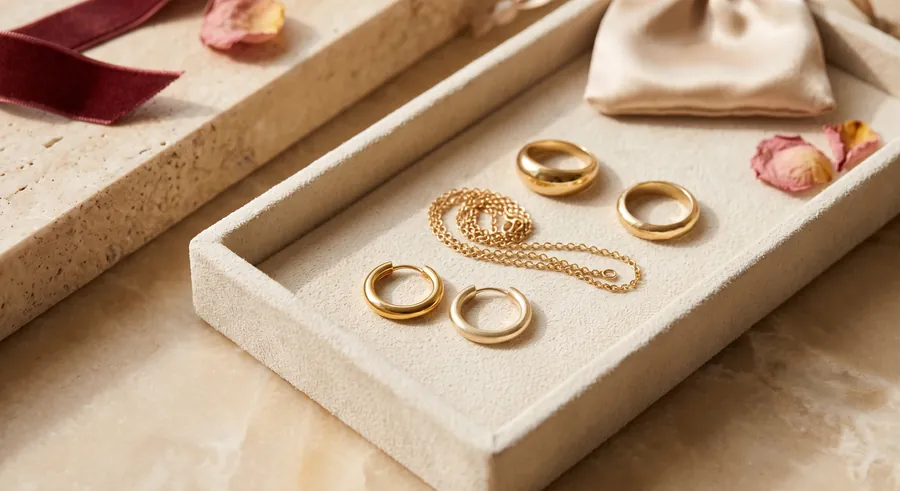
If you are building slowly, the order that serves most people is a pair of solid gold hoops or studs, a chain at 45 centimetres that suits your neckline, and then one piece with a stone. All in 14 or 18 karat, all solid, all bought once. The Jewel Box tool will show you how chain lengths fall on a neckline before you order, which is the question that causes most returns.
Try the tool
Jewel BoxRing gauge, chains and stonesQuestions we get asked
Is 18 karat too soft for an engagement ring?
No, and it is the European standard for exactly that purpose. Setting design matters more than karat: a bezel or low profile protects a stone far better than high claws in any metal.
Can yellow and white gold be worn together?
Yes. Mixing metals has been standard in fine jewellery for over a century. The only caution is that a harder metal worn beside a softer one will slowly wear it.
Does gold jewellery need insuring separately?
Above roughly a thousand euro, yes, on a named-item basis with a recent valuation. Standard household cover usually caps single items well below that.