
The four Cs were devised by a diamond trade organisation in the 1940s and have been repeated in every jewellery shop since. They are genuinely useful, but they are usually presented in the wrong order and with the wrong emphasis, which reliably moves buyers towards the grades that cost most and show least.
Cut, which is most of it
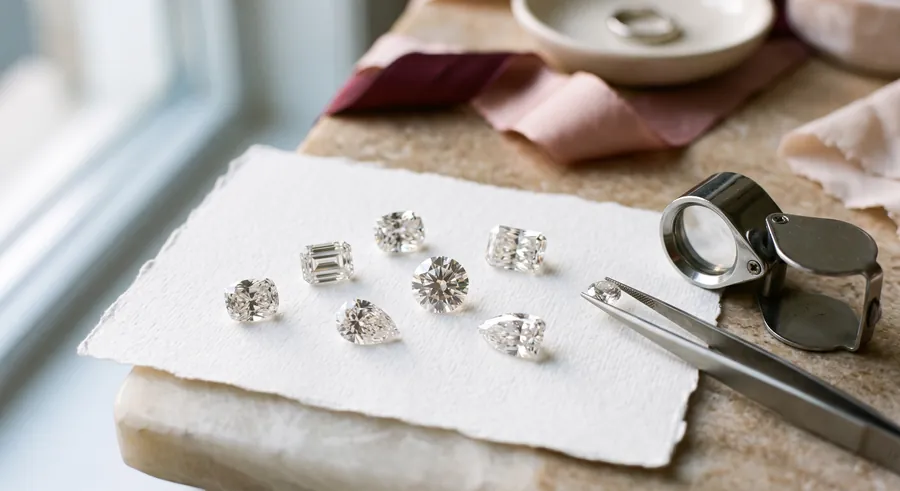
Cut is not the shape. Cut is the quality of the proportions, symmetry and polish, and it determines how much light entering the stone comes back to your eye. It is responsible for perhaps 60 per cent of what a person perceives as beauty in a diamond, and it is the one C that cannot be compensated for by anything else.
On a round brilliant, buy Excellent or Ideal cut and nothing less. The difference between an Excellent cut stone and a Good one at identical weight and colour is immediately visible across a dinner table and typically costs 10 to 15 per cent. It is the best value in the entire purchase. On fancy shapes such as oval, pear and emerald, no standard cut grade exists, so judge by eye: look for even brightness with no dark bow-tie across the centre.
Two stones of identical weight and grade can look entirely different across a table. The one that sparkles was cut for light, not for the scales.
Colour, where the money is usually wasted
The scale runs from D, which is colourless, to Z. The prices fall steeply as you descend, and the visible difference does not. In a mounted stone under normal light, most people cannot distinguish D from G. The sweet spot is G to I for white gold or platinum settings, and J to K for yellow gold, where the warmth of the metal makes a slightly warmer stone look whiter than it is.
Paying for D colour buys a certificate rather than an appearance, unless the stone is very large or set in an entirely colourless mount.
Clarity, where the money is almost always wasted
Clarity describes internal inclusions, graded from Flawless down through VVS, VS, SI to I. The phrase that matters is eye clean: no inclusion visible to an unaided eye at normal distance. VS2 is reliably eye clean. SI1 usually is, and should be checked. SI2 sometimes is, and is where an experienced buyer finds a bargain and an inexperienced one finds a visible black speck.
The step from VS2 to VVS1 can add 20 per cent to the price for a difference visible only under ten times magnification, which is a strange thing to buy for a ring worn at arm’s length.
Carat, and the price steps
Carat is weight, not size, and price does not rise smoothly with it. There are sharp steps at the round numbers, particularly at 1.00, 1.50 and 2.00 carats, because demand clusters there. A 0.92 carat stone can cost 20 per cent less than a 1.01 and is about three per cent smaller in diameter, which nobody has ever noticed on a hand.
Buying just below the round numbers is the single most effective saving available in diamond purchasing, and no shop will suggest it.
Certificates, grown stones and where to buy
For anything above about half a carat, insist on a report from GIA or, in Europe, HRD or IGI, and understand that grading between laboratories is not identical; GIA is the strictest and its grades are the benchmark. Below half a carat, the certificate often costs more than the information is worth.
Laboratory grown diamonds are chemically and optically identical to mined ones, cost roughly a fifth as much and have fallen steadily in price as production expands. That makes them an excellent way to buy a larger, better cut stone for a fixed budget and a poor way to store value. If resale matters, buy vintage: an estate piece bought well is the only category of jewellery most people can sell without losing half.
Our Jewel Box tool includes a scale ring gauge you can print, a chain length visualiser and a plain comparison of stones by hardness and daily wearability, which is the question most buying guides forget to answer.
Try the tool
Jewel BoxRing gauge, chains and stonesQuestions we get asked
Is a certificate necessary for a small stone?
Below half a carat, generally not; the grading fee is disproportionate. Buy from a jeweller who will put the grade in writing on the receipt instead.
Do grown diamonds test as real?
Yes, on standard diamond testers, because they are diamond. Specialist equipment distinguishes them, and reputable sellers disclose the origin as a matter of course.
What about sapphires and other coloured stones?
The four Cs apply loosely, but colour dominates almost entirely and treatment disclosure matters more than clarity grade. Heat treatment is standard and acceptable; fracture filling is not.