Walk into a room that feels wrong and the cause is nearly always the light. It comes from a single fitting in the centre of the ceiling, it is too cold, it cannot be dimmed, and it casts every face and every surface in the same flat wash. Furniture cannot recover from that, and neither can paint.
The fix is inexpensive, requires no permission from a landlord and takes an afternoon.
Three sources, three heights
A room needs light at three levels, and the ceiling is not one of them.
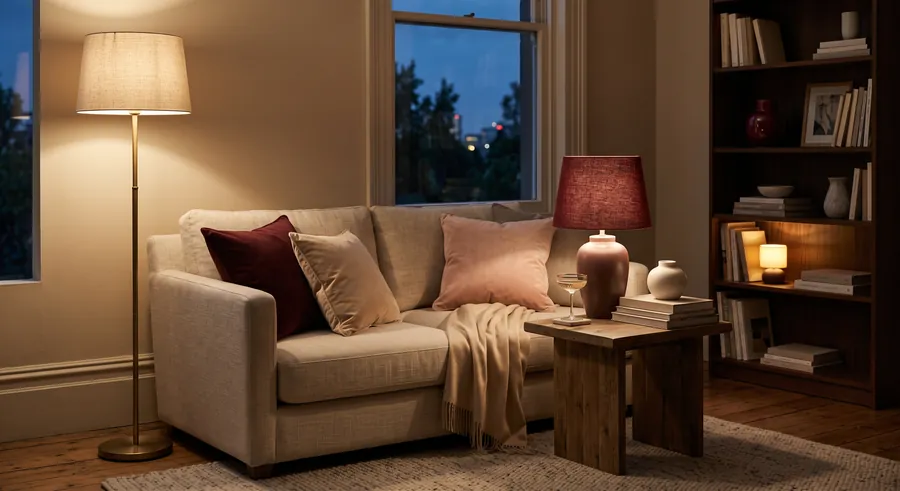
- Eye level when seated, roughly 110 to 130 centimetres: a table lamp on a side table or console. This is the light that does most of the work and the one that makes faces look well.
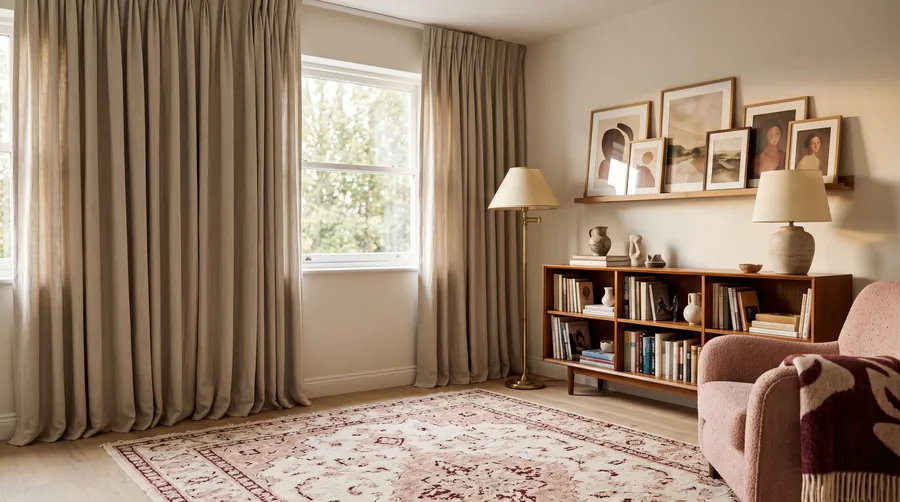
- Standing height, 150 to 180 centimetres: a floor lamp in a corner, ideally one that washes a wall rather than pointing into the room. Corners are where rooms go dark and where a single lamp changes the perceived size of the space.
- Low, below 60 centimetres: a small lamp on a shelf, a picture light, a candle. This is what makes an evening room feel like a room rather than a workspace.
Three of those and the ceiling fitting can be left off permanently, which is the recommendation. If you must have overhead light for cleaning or cooking, put it on its own switch and treat it as a utility.
Every hotel room you have ever admired had four lamps and no working ceiling light. That is not an accident, it is the entire trick.
Colour temperature, which is the second problem
Measured in kelvin, and the number is printed on every bulb box. Below 2,700 K is warm and slightly golden, which is what you want in a living room or bedroom. Around 2,700 to 3,000 K is the standard warm white and works everywhere in a home. Above 4,000 K is the cool blue-white of an office or a bathroom mirror, and it is the reason a beautifully furnished room can feel like a waiting area.
Buy everything at 2,700 K, keep every bulb in a room at the same temperature, and put a 3,000 K bulb only where you need to see detail. Mixed temperatures in one room read as untidy even to people who could not name why.
Brightness and dimming
Lumens replaced watts and confuse everyone. As a rough guide: 400 lumens for a bedside lamp, 800 for a general table lamp, 1,500 or more for a floor lamp lighting a corner. What matters more is that every fitting in a living room and a bedroom should dim. Dimmable bulbs cost a euro or two more and plug-in dimmer cords cost about fifteen, which is the highest return per euro available in a home.
Shades, and why they matter
A shade decides where the light goes. An opaque drum sends it up and down and leaves the middle dark, which is right beside a sofa and wrong as a room’s only light. A pale linen or paper shade glows and lights the whole room. Silk lined in gold gives that warm hotel light people try to buy with expensive bulbs. Line the inside white for brightness, gold for warmth, and avoid anything that leaves a bare bulb visible at seated eye level.
What to add after the lamps
Once three lamps are in place, two more things earn their cost. A picture light or a small directional lamp aimed at something worth looking at, which gives the eye a destination. And candles, actual ones, at a level below eye height. Every restaurant you have enjoyed sitting in was doing exactly this.
Our Room Palette tool builds a colour scheme from your room’s aspect and the light it actually gets, since a north-facing room and a south-facing one need different answers to the same question.
Try the tool
Room PaletteColour that suits your lightQuestions we get asked
What if the room has no sockets in the right places?
A flat cable run under a rug and a well-placed extension solve most of it. In a rental, a floor lamp beside the sofa and a table lamp on a shelf need only two sockets between them.
Are smart bulbs worth it?
For dimming and scheduling in a rental where you cannot fit dimmer switches, yes. Buy warm white and ignore the colour-changing feature, which nobody uses after the first week.
How do I light a room with a very high ceiling?
Ignore the ceiling entirely and light the walls. Uplighters in corners and a pendant dropped to about 150 centimetres above a table bring the perceived ceiling down to a human scale.