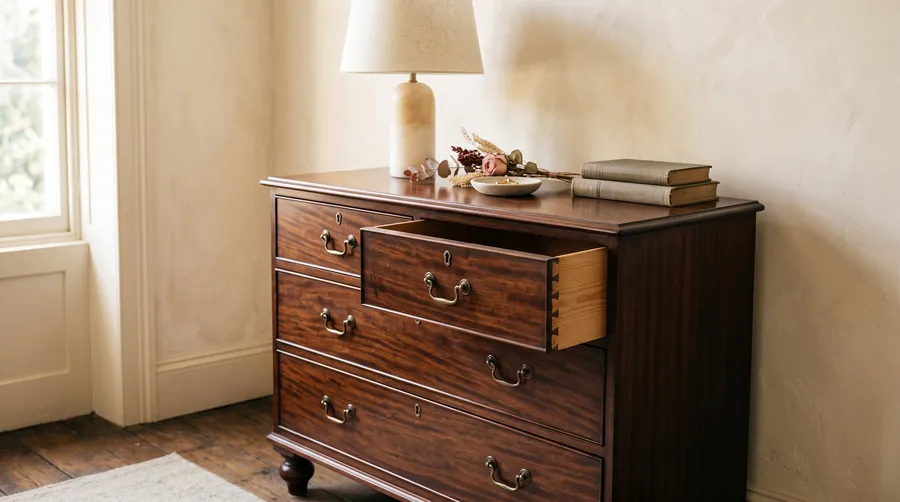

The furniture market contains one of the strangest price inversions in retail. A Victorian chest of drawers in solid mahogany, dovetailed, with a hundred and thirty years of use already behind it, sells at a regional auction for 80 to 200 euro. A new chest of drawers in veneered particle board, which will sag within a decade, costs 300. The old one is better in every measurable respect and cheaper.
This inversion exists because brown furniture went out of fashion around 2005 and supply has vastly exceeded demand ever since. It will not last forever, and it is currently the best value available to anyone furnishing a home.
The four things to buy new
- The mattress. Non-negotiable, for hygiene and because support degrades invisibly. Between 400 and 900 euro buys most of what is available.
- The sofa, unless you are having it reupholstered. Foam collapses, frames loosen, and a second hand sofa is usually somebody else’s worn-out one. Buy a serrated or sprung frame in hardwood, feather-wrapped foam cushions, and a removable cover.
- Anything with electrics or gas. Obviously.
- Mirrors above a certain size, where old glass is beautiful but heavy and the fixings are frequently unsafe.
A mahogany chest of drawers from 1890 costs less at auction than a flat-packed equivalent, and one of them will still exist in 2090.
What to buy old, and what to pay
Dining tables, chairs, chests of drawers, bookcases, side tables, desks, lamps, mirrors, rugs, and anything made of solid wood. Rough guidance from European regional salerooms in 2026: a set of six mid-century dining chairs, 200 to 500 euro. A solid oak or mahogany chest, 80 to 250. A large Victorian bookcase, 150 to 400. A good Persian rug in wool, 300 to 900 for something that will outlive you. Add the buyer’s premium of 20 to 28 per cent to all of these.
How to judge a piece quickly
- Open a drawer and look at the joints. Dovetails mean a cabinetmaker. Staples and glue mean a factory.
- Check whether it is solid or veneered, by looking at the edge of the top. Veneer over solid wood is fine and traditional; veneer over particle board is not.
- Push it gently at the top corner. Racking movement means loose joints, which is a 60 to 150 euro repair rather than a disqualification.
- Smell the inside. Damp and mould are difficult to remove and often come with woodworm.
- Look for active woodworm: fresh, pale dust below clean-edged holes. Old holes with no dust are historical and harmless.
Reupholstery, which changes the arithmetic
A well-made old armchair with a hardwood frame and sprung seat, bought for 60 euro and reupholstered for 400 to 800 including fabric, gives you a chair better than a 1,200 euro new one and in exactly the fabric you want. This is the standard route to good seating on a moderate budget and the reason upholsterers are worth finding before you need one. Ask for a quote before you buy the chair; a good upholsterer will tell you honestly whether the frame is worth the work.
Mixing old and new
A room entirely of antiques is a museum and a room entirely new is a showroom. The pleasant version is roughly one new piece to three old, with a modern sofa, modern lighting and everything else with a history. It is also how almost every interior you have admired in a magazine was assembled, whatever the caption said.
Try the tool
Room PaletteColour that suits your lightQuestions we get asked
Is antique furniture difficult to live with?
The Georgian and Victorian pieces that survive were built for daily use and are considerably more robust than modern equivalents. Only fragile marquetry and gilt need special care.
How do I get large items home?
Auction houses keep lists of local carriers, usually 60 to 200 euro within a region. Factor it into your maximum bid before the sale rather than after.
What about woodworm?
Treated and inactive is common and harmless. Active infestation is treatable with a proprietary fluid but keep the piece isolated until it is done, since it can spread to other furniture.