
Solo travel is discussed either as an act of self-discovery or as a risk assessment, and both framings get in the way. It is simply travelling without having to negotiate, which brings enormous freedom and two specific difficulties: the first evening, and dinner. Solve those two and the rest is straightforwardly better than travelling with company.
The base matters more than anything
Choose a hotel with a proper public space: a bar, a breakfast room, a courtyard, a reception with a human being in it. A beautifully designed apartment with a keybox is the loneliest possible option and is where solo trips go quiet. Small hotels of fifteen to thirty rooms are ideal; large chains are anonymous and hostels are exhausting after about thirty.
Location does more work when alone than in company. Being able to walk home means you are not weighing a taxi against leaving early, and that changes what you do with an evening.
The difference between a lovely solo trip and a lonely one is almost never courage. It is scaffolding, built in advance, for the two hardest hours.
The first evening, planned in advance
Arrival is the vulnerable hour: you are tired, the room is silent, and the temptation is a sandwich and a phone. So plan it before you leave home. Book a table for the first night, ideally somewhere with a counter or a bar. Or book a food tour, a concert, a guided evening walk for that first evening specifically. It costs 30 to 60 euro and it sets the whole trip going.
Eating alone, which is a learnable skill
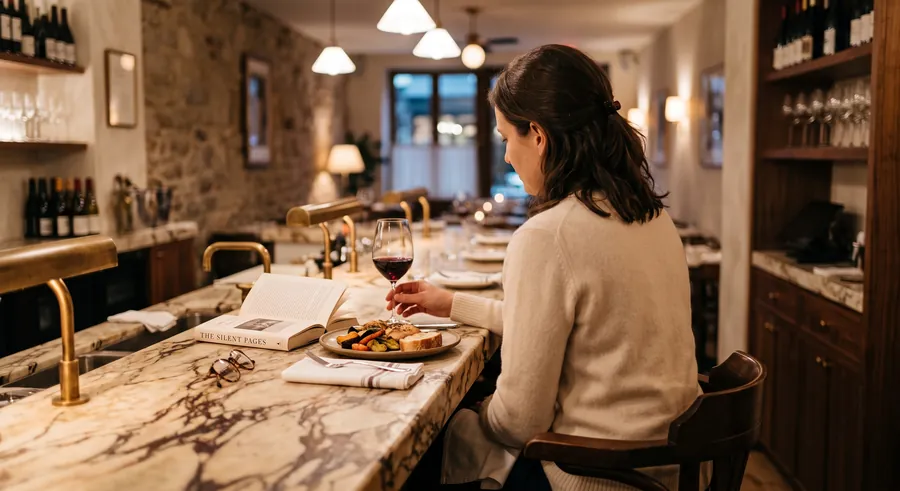
Lunch is easier than dinner, so put the ambitious restaurant at lunch and eat simply in the evening. Sit at the bar or the counter where there is one, because bar staff talk to solo diners and tables do not. Book early, around seven, when a restaurant has time for you. Bring a book, not a phone; a book signals contentment, a phone signals waiting for someone.
And take the good restaurant seriously. Solo diners are welcome at almost every level of dining, and the notion that a single person cannot occupy a two-top on a Tuesday is a fear rather than an experience.
Sensible, proportionate precautions
- Share your itinerary and hotel address with one person at home, and message on arrival. Not because the world is dangerous, but because it costs nothing.
- Arrive in daylight where you can, particularly on the first day in an unfamiliar city.
- Keep a card with the hotel address in the local language, and enough cash for a taxi if your phone dies.
- Trust the discomfort signal. Leave the bar, change carriages, take the longer route. You never owe anyone an explanation for it.
- Download offline maps before you land. A woman standing still looking at a phone is the one situation worth avoiding, and offline directions solve it.
The pleasures nobody mentions
You will eat when you are hungry, look at one painting for twenty minutes, change the plan at eleven in the morning because the light is good, and go to bed at nine without apologising. You will also talk to more people in three days than in a fortnight with company, because a person alone is approachable and a couple is a closed room.
Start with somewhere easy if it is your first time: Lisbon, Copenhagen, Vienna, Edinburgh, Ljubljana. Compact, walkable, safe, English widely spoken, and full of people eating alone at counters looking perfectly content.
Questions we get asked
Is solo travel more expensive?
Somewhat, because of single occupancy rates. Choose hotels with genuine single rooms, travel off season, and remember there is no compromise spending on things you do not care about.
Which destinations suit a first solo trip?
Compact European cities with good public transport and a strong café culture. Lisbon, Vienna, Copenhagen, Edinburgh and Bologna are all forgiving and rewarding.
How do I meet people without a hostel?
Classes, guided walks, hotel bars and counters at good restaurants. Three hours of a cookery class produces more conversation than three nights in a dormitory.