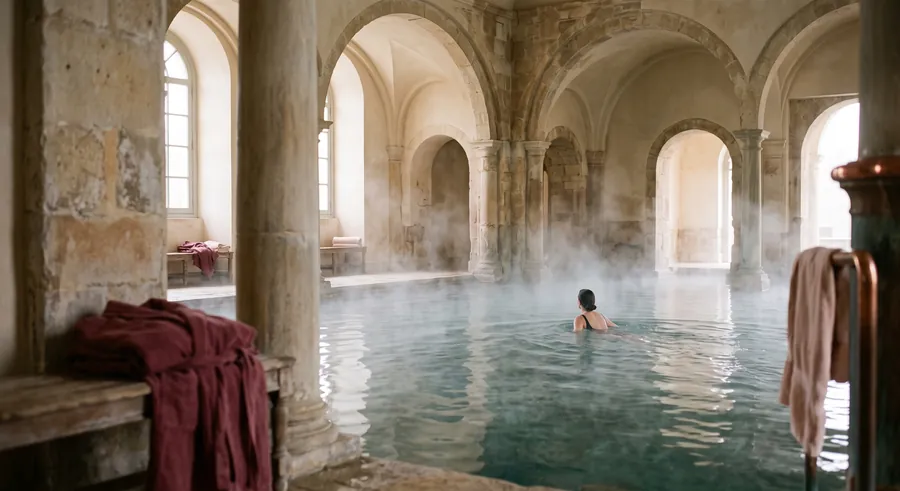
Thermal bathing in Europe divides into three traditions that are frequently confused when booking. The medical tradition, strongest in Germany, Austria, Hungary and the Czech Republic, treats water as therapy with doctors, prescriptions and a slightly clinical atmosphere. The social tradition, best seen in Budapest and in Japan’s influence on newer builds, treats bathing as something you do with other people for several hours. The architectural tradition, exemplified by Vals in Switzerland, treats the bath as a building to be experienced.
Knowing which you want prevents the most common disappointment, which is booking a serious cure hotel when what you wanted was a beautiful afternoon in hot water.
For a first thermal trip: Budapest
Nowhere else offers this concentration. Széchenyi is vast, yellow, outdoors and gloriously sociable, with men playing chess in 38 degree water in February. Gellért is Art Nouveau and quieter. Rudas is Ottoman, small, and has a rooftop pool over the Danube. Three nights, a bath a day, and the city itself between them. Entry runs 20 to 35 euro, and November through March is the season, because steam and cold air together is most of the pleasure.
Hot mineral water does something for a tired person that no treatment menu can improve upon. Everything else in a spa is decoration around that fact.
For actual treatment: Baden-Baden and the Czech spa triangle
Baden-Baden’s Friedrichsbad is a seventeen-station Roman-Irish circuit taking about three hours, textile free and strictly silent, and it is one of the great experiences in European bathing. The town also holds a serious medical tradition, as do Karlovy Vary and Mariánské Lázně, where three-week cures with doctors, drinking water and diet are still prescribed and reimbursed in several countries. Expect earnestness rather than atmosphere, and considerable value.
For landscape: Iceland and the Dolomites
The Blue Lagoon is famous, expensive and, being man-made from power station outflow, less interesting than it sounds. The Sky Lagoon near Reykjavík and the Mývatn Nature Baths in the north are better, and the country is dotted with municipal hot pots costing a few euro where Icelanders actually go. In the Dolomites and South Tyrol, the appeal is thermal water with mountain windows, particularly at Merano, and the walking on either side of the bath is half the trip.
For beauty: Tuscany and Slovenia
Saturnia’s cascade pools are free, open all night and unforgettable at six in the morning before the coaches; Bagno Vignoni is a village built around a bath in its main square. Slovenia offers the best value in Europe for proper spa hotels, with Rogaška and the Terme regions running full board at prices that would buy a room alone in Austria.
For a single perfect day: Vals and Bath
Peter Zumthor’s 7132 Therme at Vals is a building people travel to see and bathe in, and it is limited, expensive and worth it. The Thermae Bath Spa in England puts you in the only natural hot spring in the country with a rooftop view over a Georgian city, which is a very pleasant two hours.
Practical notes
Book treatments before you arrive at any serious spa, since the good slots go weeks ahead. Take flip-flops, a proper towel and a robe if the hotel does not supply one, since hiring costs 10 to 15 euro a day. Hydrate more than feels necessary and do not drink alcohol between baths. And be aware that textile-free bathing is standard in Germany, Austria and much of Switzerland, including in mixed areas; it is far less awkward than anticipated and is not optional in those sections.
Questions we get asked
Is thermal water medically effective?
For musculoskeletal pain and some skin conditions the evidence is reasonable; for most other claims it is thin. The reliable benefits are heat, buoyancy, rest and the absence of a telephone.
What should I take?
Swimwear, flip-flops, a water bottle, a robe if not provided, and a hair tie. Leave jewellery at the hotel, since sulphur water blackens silver and can damage plated pieces.
Are spa hotels worth it over day entry?
If the hotel has its own thermal source, yes, because you can bathe early and late when the day visitors have gone. If it merely has a pool, pay for day entry at the real bath instead.