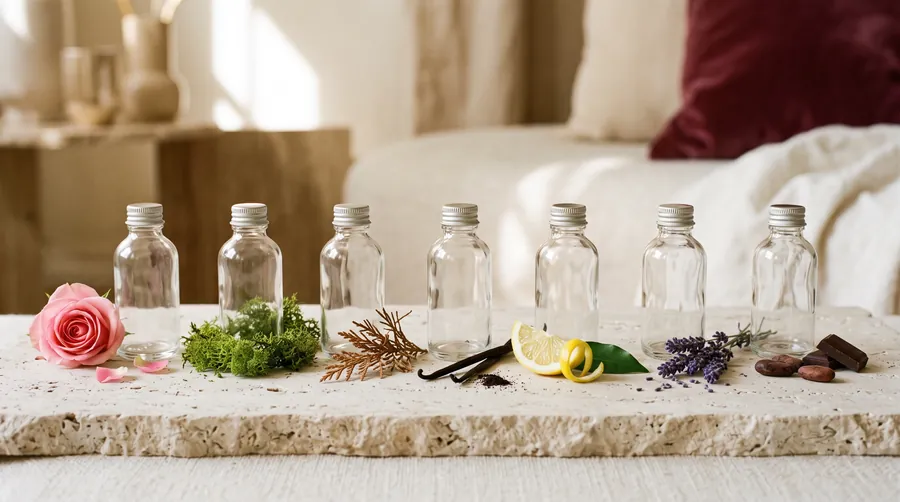
The way perfume is sold is designed to produce a purchase, not a match. Bright light, several sprays in quick succession, an assistant who is being helpful, and a nose that stops distinguishing anything after the fourth attempt. It is a poor environment for a decision you may live with for a decade.
The alternative takes about six weeks and almost no money, and it works.
Week one: establish what you already know
List every scent you have loved, including ones from childhood, ones on other people, and things that are not perfume at all: bakery, cut grass, petrol, church incense, tomato leaves, the inside of a leather bag. Write down the family of each perfume on the list. A pattern nearly always appears, and it is more specific than you expect.
Weeks two and three: sample properly
Buy sample decants rather than visiting counters. Several online decanting services sell 2 millilitre vials of almost anything for a few euro, which is roughly forty wearings and enough to know. Choose eight, no more, weighted towards the two families you identified.
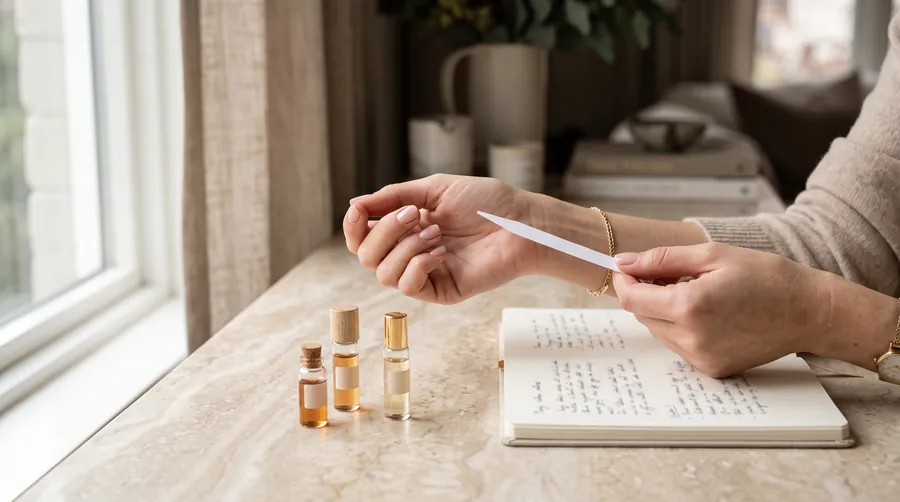
Then the rules that make testing meaningful. One perfume per day, on skin, never on paper. Two sprays, one on each wrist, applied in the morning before coffee. Do not rub the wrists together, which crushes the top notes. Then go about an ordinary day and pay attention at four specific moments: after ten minutes, after one hour, after four hours and at bedtime.
The perfume you should buy is not the one you admire on the card. It is the one you keep lifting your own wrist to check.
Why the fourth hour matters
A fragrance is built in layers with different evaporation rates. The top notes, usually citrus and light herbs, are gone within fifteen minutes. The heart takes over for two to four hours. The base, made of resins, woods and musks, is what you actually wear for the rest of the day and what other people smell when they hug you.
Nearly every purchase mistake is made at minute two, when the top notes are seducing you, and regretted at hour five, when the base has arrived and is not what you agreed to. Judge at four hours or do not judge.
Week four: eliminate
Of eight samples, two will be immediate no. Three will be pleasant and forgettable, which is also a no; a signature scent should not be merely inoffensive. That leaves three. Wear each of those for three consecutive days, which reveals whether you like the perfume or merely liked the novelty. Novelty rarely survives day two.
Weeks five and six: the test that matters
Take the two survivors and wear them into your actual life: a work day, a cold morning, a warm room, an evening out, a Sunday doing nothing. Notice whether you reach for your own wrist. Notice whether anyone says anything, and, more tellingly, whether you feel like yourself. A signature scent is not the one that gets the most compliments; it is the one you stop noticing on yourself while other people continue to.
Then buy small
Buy the 30 or 50 millilitre bottle even if the 100 is better value. Perfume degrades in two to four years once opened, faster in a warm bathroom, and taste changes. The person who buys 100 millilitres of everything owns a shelf of half-full bottles she no longer wears.
And keep the list from week one. In five years, when you want to change, it will still be pointing in the right direction.
Try the tool
Fragrance CompassMap your scent in five slidersQuestions we get asked
Should I have one signature or several?
Three is the practical answer for most people: a working day scent, something warmer for evening, something light for high summer. A single signature is a lovely idea and slightly impractical across a European year.
Does perfume really smell different on different people?
Yes, mainly through skin oil, temperature and pH, which change how fast each layer evaporates. The difference is largest in the first hour and smaller at the base.
Is it worth buying vintage bottles?
Only from a seller who stores them properly. Top notes turn first and a badly kept vintage smells sour at the opening even when the base is intact.