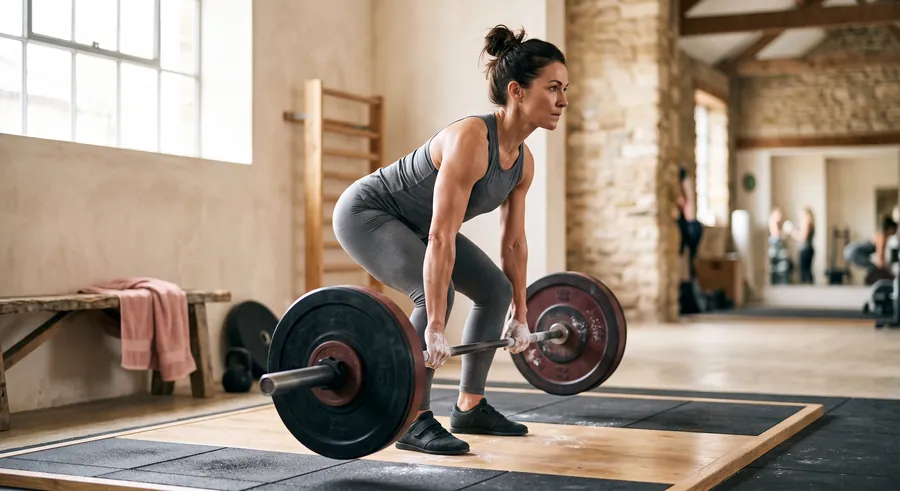

The case for lifting weights is no longer seriously contested. Resistance training preserves muscle mass and bone density, both of which decline from the fourth decade onwards and decline faster after menopause; it improves insulin sensitivity, balance and metabolic rate; and it is the single best predictor available of independence in later life. What remains contested, mostly by people selling programmes, is how much of it you need.
The minimum effective dose
The research on training volume converges on something reassuring. Most of the strength gain available to a non-athlete comes from the first two sessions a week. A third session adds meaningfully less, a fourth adds little for most people, and the returns beyond that are for competitors.
What matters more than frequency is that the effort is genuine. A set taken to within two or three repetitions of failure produces most of the adaptation; a set of fifteen comfortable repetitions with a pink dumbbell produces almost none. This is the part that women have historically been taught wrongly, and correcting it changes everything.
The women who keep training are not the ones with the best programme. They are the ones with a programme short enough to survive a bad week.
A programme that fits in forty minutes
Two full-body sessions, three sets of each movement, six to ten repetitions, resting ninety seconds between sets.
- A squat pattern. Goblet squat, leg press or split squat.
- A hinge pattern. Romanian deadlift or hip thrust. This is the most valuable movement for most women and the most commonly skipped.
- An upper body push. Press-up on any incline, or a dumbbell shoulder press.
- An upper body pull. Assisted pull-up, lat pulldown or a row.
- A carry or a plank. Ninety seconds, heavy, twice.
That is the whole thing. Two sessions of that, done properly for a year, will change your body composition, your posture and what your seventy-year-old self can lift. Our Ritual Week tool places these sessions in a real week alongside sleep and rest, which is where most plans fail.
Progression, which is the actual programme
Add either a repetition or a small amount of weight whenever the last set feels manageable. That is it. When you can complete three sets of ten with good form, increase the load by the smallest available increment and drop back to sets of six. This cycle, repeated, is what separates people who get stronger from people who exercise.
Write it down. Not on an app you will abandon, but in a notebook or a note on your phone: date, movement, weight, repetitions. Progression is invisible week to week and obvious over three months, and the record is what keeps you going through the invisible part.
The forty-plus question
Through perimenopause and after, the decline in oestrogen accelerates loss of both muscle and bone, and recovery slows. The response is not to train less; it is to train with more attention to protein, at least 1.6 grams per kilogram of body weight per day, and to sleep, which is when adaptation actually happens. Some evidence suggests heavier loads and lower repetitions are particularly protective of bone density after menopause. If you are considering hormone therapy, that is a conversation for a doctor and a good one to have.
What about cardiovascular work
Walking covers most of it. Seven to eight thousand steps a day is associated with most of the mortality benefit available from walking, with diminishing returns beyond. Add one session a week that leaves you genuinely breathless, in whatever form you enjoy, and the aerobic side is handled without a single minute on a treadmill you resent.
Try the tool
Ritual WeekA week that restores youQuestions we get asked
Do I need a gym?
It helps for progression, because adding load is what drives adaptation. A pair of adjustable dumbbells and a bench at home covers the first year for most people.
Is it too late to start at sixty?
No. Studies in people over seventy consistently show significant strength gains within twelve weeks. The rate of improvement in a beginner is remarkable at any age.
Should I train differently around my cycle?
Some women feel noticeably stronger in the follicular phase and adjust loads accordingly. The evidence for formal cycle-based programming is weak, so the practical answer is to train consistently and be flexible on the hard days.